Hitler Didn't Escape to Argentina: Why I Believe He Simply Assumed His Next Role


This image is AI generated based on my nlog information.
Introduction: When Alternative Explanations Become Another Form of Containment
Most people know the official story.
According to the accepted historical narrative, Adolf Hitler died in a bunker beneath Berlin in April 1945 as the Third Reich collapsed around him.
For decades, anyone who questioned that narrative was dismissed as a conspiracy theorist.
Then something interesting happened.
Alternative theories became mainstream enough that even major media outlets, documentaries, books, and researchers began discussing the possibility that Hitler escaped.
The most common alternative explanation became Argentina.
According to this theory, Hitler survived the war, escaped Europe through secret routes, and lived out the remainder of his life in South America.
Many people see this as the hidden truth behind the official story.
I once considered that possibility myself.
But over time I began asking a different question.
What if the Argentina theory functions as a containment narrative?
What if it exists to redirect people who have already stopped believing the official story?
What if the purpose is to keep researchers inside a material explanation while preventing them from exploring more disturbing possibilities?
This article is not an attempt to force anyone into my conclusions.
I am not asking readers to blindly accept my interpretation.
I am simply documenting where my own research, observations, and theological convictions have led me.
And those conclusions are far stranger than either the official story or the Argentina story.
I no longer believe the most important question is whether Hitler died in Berlin.
Nor do I believe the most important question is whether Hitler escaped to Argentina.
The question that interests me is this:
What if Hitler simply assumed his next role?


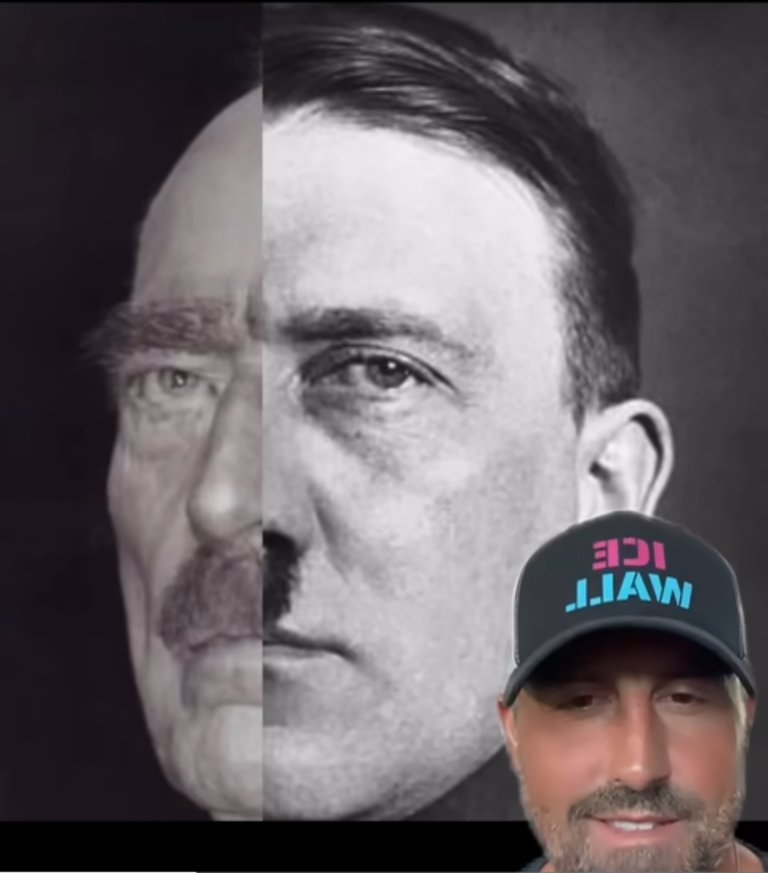
 These screenshots are credited to Tyler Hanson also known as the fittest flat earther.
The Pattern That Changed My Thinking
One of the reasons I began reconsidering conventional explanations was the work of independent researchers who compare historical figures through facial analysis and recurring archetypes.
One comparison in particular caught my attention.
The comparison between Adolf Hitler and Fred Trump.
At first glance many people immediately reject the idea.
The mind is trained to do so.
We are conditioned to assume that similarities between historical figures are coincidence.
But when enough similarities accumulate, coincidence begins to feel less convincing.
I am not speaking only about general resemblance.
I am speaking about facial architecture.
Eye placement.
Facial proportions.
Skull shape.
Jaw structure.
Nasal geometry.
Recurring facial markers.
Small details that continue appearing in the same locations.
Individually, any one feature means very little.
Collectively, they become harder to dismiss.
The question is not whether two people can resemble one another.
The question is how many similarities must exist before the explanation of coincidence becomes insufficient.
For me, that question opened the door to a much larger investigation.
Why I No Longer Believe the Argentina Story Is the Final Answer
The Argentina theory serves an important role.
It provides an alternative explanation for people who no longer trust the official narrative.
But it also creates a new boundary.
Instead of asking whether Hitler truly disappeared, researchers become trapped debating where he supposedly lived afterward.
The discussion remains confined to geography.
The deeper questions never emerge.
The conversation becomes:
Did he die in Berlin?
Or did he live in Argentina?
What if those are not the only options?
What if both sides of the debate are operating within assumptions that should be challenged?
What if the issue is not survival?
What if the issue is continuity?
What if the historical figure known as Adolf Hitler represents part of a larger recurring pattern?
That possibility sounds extreme.
Yet history is filled with recurring archetypes.
The conqueror.
The empire builder.
The false savior.
The revolutionary.
The technocrat.
The charismatic ruler.
Again and again these roles emerge.
The faces change.
The names change.
The eras change.
Yet the archetypes remain remarkably consistent.
That consistency raises important questions.
The Ancient World Understood Power Differently
Modern society generally interprets history through a material lens.
Kings are political actors.
Empires are economic systems.
Wars are conflicts over resources.
Technology is merely innovation.
Ancient people often viewed these realities differently.
The biblical worldview presents earthly events as reflections of deeper spiritual realities.
Nations were not seen as isolated political entities.
Kings were not merely administrators.
Empires were not spiritually neutral.
The Hebrew Scriptures repeatedly connect earthly power with heavenly realities.
The book of Daniel describes spiritual princes associated with nations.
Second Temple literature expands on these ideas.
The Book of Enoch presents a world in which rebellion among heavenly beings influences human civilization.
Ancient Jewish traditions frequently understood history as unfolding on both earthly and heavenly levels simultaneously.
Whether one accepts every aspect of those traditions is not the point.
The point is that the ancient worldview allowed for realities that modern materialism rejects entirely.
That difference matters.
Because if the ancient worldview contains truth, then history may be operating according to rules most modern people no longer recognize.
The Enochic Framework
The Book of Enoch describes heavenly beings who rebelled against the divine order.
These beings introduced corruption, violence, forbidden knowledge, and disorder into human civilization.
Many readers immediately think of technology when they encounter these passages.
Enoch portrays advanced knowledge being transmitted to humanity.
Knowledge that accelerated civilization while simultaneously accelerating corruption.
That pattern is fascinating.
Throughout history technological advancement is often presented as inherently positive.
Ancient literature offers a more complicated picture.
Knowledge can elevate.
Knowledge can also corrupt.
Knowledge can empower.
Knowledge can also enslave.
The modern world often assumes technological progress automatically equals moral progress.
History suggests otherwise.
The twentieth century was among the most technologically advanced periods in human history.
It was also among the most destructive.
That tension should cause us to think more carefully about the relationship between knowledge, power, and civilization.
The Recurring Ruler Archetype
One concept I find increasingly difficult to ignore is the recurring ruler archetype.
History repeatedly produces figures who embody remarkably similar roles.
Different names.
Different eras.
Similar patterns.
The public tends to focus on personalities.
I focus increasingly on archetypes.
The ruler who promises national restoration.
The leader who channels public frustration.
The figure who becomes larger than life.
The man whose image becomes inseparable from a movement.
These patterns appear repeatedly.
Sometimes the similarities are ideological.
Sometimes they are symbolic.
Sometimes they appear visual.
And sometimes they seem to combine all three.
This does not prove any particular theory.
But it does suggest that history may operate through recurring templates.
Templates that emerge again and again.
Could the Public Stage Be More Scripted Than We Realize?
One possibility that increasingly interests me is that history may be far more curated than most people imagine.
Not necessarily through simple conspiracies.
Not necessarily through secret meetings.
But through the repetition of archetypes.
Certain figures appear at key moments.
Certain narratives emerge at specific times.
Certain symbols repeat.
Certain mythologies persist.
The same themes continue appearing across generations.
The public assumes history is chaotic.
I increasingly suspect history may be more theatrical than chaotic.
That does not mean every event is scripted.
It means recurring patterns deserve investigation.
The Question Most People Never Ask
Most people ask:
Did Hitler die?
Others ask:
Did Hitler escape?
Very few ask:
Why do similar archetypes continue appearing throughout history?
Why do certain faces seem familiar?
Why do the same symbolic roles reappear?
Why do power structures repeatedly produce nearly identical narratives?
Why do certain leaders become almost mythological figures?
Why does society continually gravitate toward the same patterns?
These questions fascinate me far more than debates about geography.
Because they point toward structure.
And structure reveals deeper realities.
My Personal Conclusion
I fully understand that many readers will reject everything I have written.
That is their right.
I am not presenting these ideas as established historical fact.
I am presenting them as the conclusions I have reached after years of studying symbolism, ancient literature, elite mythology, apocalyptic traditions, and recurring historical patterns.
I no longer find the official explanation satisfying.
I no longer find the Argentina explanation sufficient.
I believe there may be something larger operating beneath both narratives.
Whether that involves recurring archetypes, hidden continuity, spiritual influence, or something else entirely remains open to investigation.
But I no longer believe the story ends where most people think it ends.
At minimum, I believe history contains patterns that deserve far more attention than they receive.
And the deeper I study those patterns, the less convinced I become that the public stage is exactly what it appears to be.
Final Thought
Perhaps Adolf Hitler died in Berlin (not).
Perhaps he escaped to Argentina (doubt it).
Perhaps neither explanation tells the whole story.
What interests me most is not where one man went.
What interests me is why the same patterns seem to return.
Again.
And again.
And again.
That is the question I continue investigating.
And for now, it remains unanswered.