Drawing with mouse: "How much of darkness..."
"How much of darkness inside us do you think we have?"
Adobe Photoshop CS3, Drawing with mouse, 2021.
My original Adobe Photoshop brushes were used during creation.
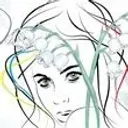
This is actually a "demonic" version of another of my artworks.
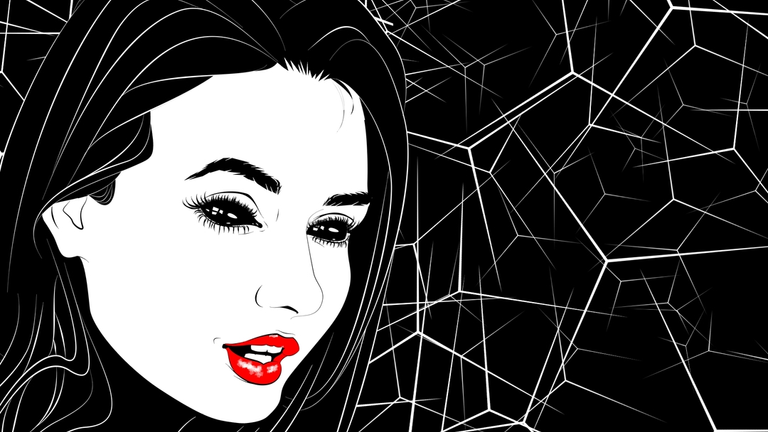
Drawing “How much of darkness inside us do you think we have?”, created in Photoshop CS3 with a mouse in 2021, is a striking visual meditation on inner tension and emotional contrast. The composition is deliberately minimal yet powerful, relying on a sharp black-and-white palette punctuated by a single, intense accent of red. This restraint gives the image clarity and focus, allowing symbolism to carry the emotional weight.
At the center is a female face rendered in clean, confident lineart. Her pale skin stands in stark contrast to the surrounding darkness, making her appear almost illuminated from within. The facial expression is calm but ambiguous—eyes half-open, gaze slightly averted, lips parted as if caught between speaking and silence. The red lips immediately draw attention, symbolizing desire, impulse, vulnerability, or even danger. They feel like the only visible wound or confession in an otherwise composed exterior.
The background is dominated by a web-like structure of sharp, angular lines stretching across a black void. These fractured geometric forms resemble cracks, broken glass, or a spider’s web, suggesting entrapment, mental fragmentation, or invisible pressures closing in. The contrast between the smooth, organic curves of the face and the rigid, chaotic geometry behind it reinforces the theme of inner conflict—the human softness set against an unforgiving internal landscape.
Technically, the drawing shows impressive control, especially considering it was made with a mouse. The clean edges, consistent line weight, and deliberate negative space reflect patience and precision. The simplicity of the palette amplifies the emotional tone, proving that complexity of feeling does not require complexity of color.
The title deepens the impact of the image. It invites the viewer to look beyond aesthetics and confront a universal question: how much darkness do we carry quietly within ourselves? Darkness here does not appear monstrous or loud; instead, it feels subtle, restrained, and internal—something that coexists with beauty and calm.
That inner darkness is often not born from cruelty, but from fear, pain, insecurity, or unresolved emotion. When ignored or suppressed, it can quietly influence decisions, pushing people toward unwise choices, harmful reactions, or self-sabotage. People rarely act irrationally without reason; more often, they are responding to inner fractures they do not fully understand or acknowledge. Your drawing captures this truth visually—the darkness is not on the face, but behind it, surrounding it, shaping it invisibly.
Ultimately, the artwork suggests that recognizing our inner darkness is not a weakness, but a necessary step toward balance. Only by seeing it clearly can we choose not to be ruled by it.
Thank you! It's nice to get support.